
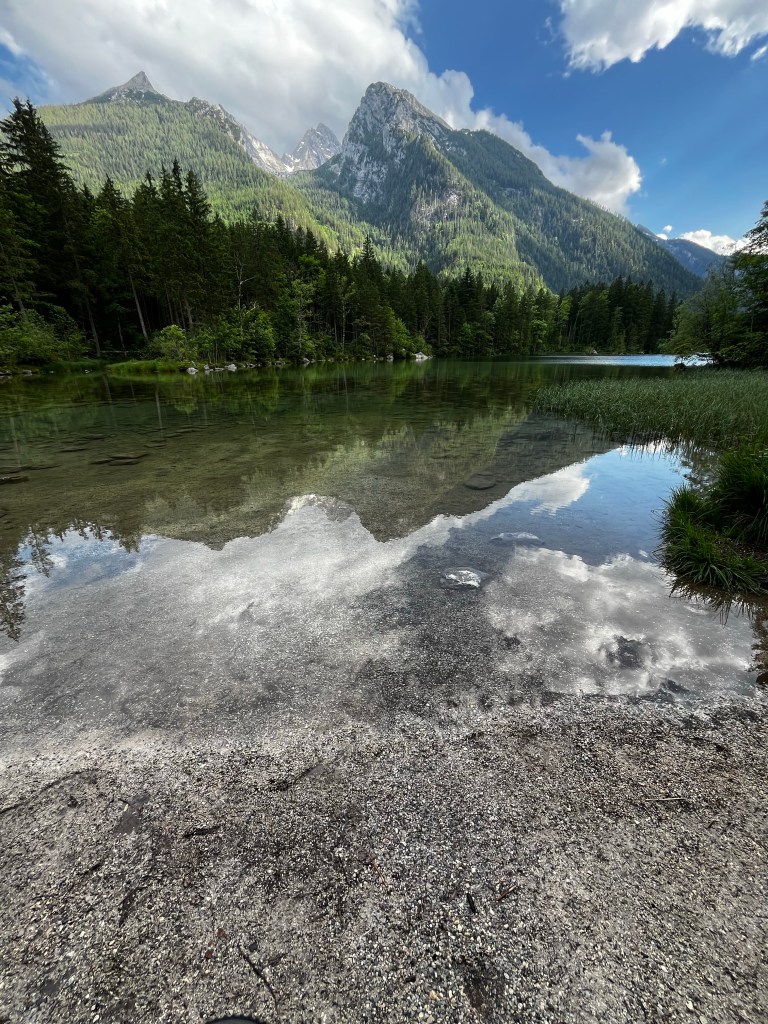
Just outside the tiny German town of Ramsau is a beautiful, alpine lake, Hintersee. The water is so clear, you can see to the pebbly bottom. And when the water is still and the sun is just right, a perfectly symmetrical reflection of the alps blooms across the water’s surface.
When Peter and I were children and our father was stationed in Munich, our family frequently took pilgrimages to Ramsau, staying at the Haus Neuhausen (the future setting or inspiration for the Pear Tree House in Polishing the Bones). A short drive from there took us to Hintersee.
Took us to where we played Beckon.
I don’t know who invented Beckon. It must have been my father and he probably played it with his brother. All I know is that I was inculcated into the rhythm and brilliant excitement of Beckon and always frowned upon the sedimentary boredom of Hide-and-Seek.
Beckon was Hide-and -Seek on steroids. The players designated a spot as Base. It stood at Base and counted and the rest of the players scattered and hid. Yeah. Sounds familiar. And then It finds the other players and then the game is over.
WRONG!
It finds the other players, and when they arrive at Base, they narrate to anyone still hiding what It is doing it where It is seeking. And that’s when the game’s hidden treasure really comes into play. Because anyone still hiding can peek out from their hiding spot and beckon at whoever is in Base and and the caught players have a ticket to sneak off Base and go hide again.
Never ending Hide-and-Seek.
I loved hiding. I hated being It because Peter was so damn good at finding the most obscure places to climb to (a leaning pine sapling) or pour himself into (boulder crevices) or hide under (the tarps in my back yard coveting my husband’s yard equipment). He was impossible to find and inventive with his hiding places. Jerk.
My father admitted to me last year that he always volunteered to be It so that he could prolong the game. He told me how he usually knew where everyone was and would deliberately amble around the playing field like a blind dunce so we could have more fun.
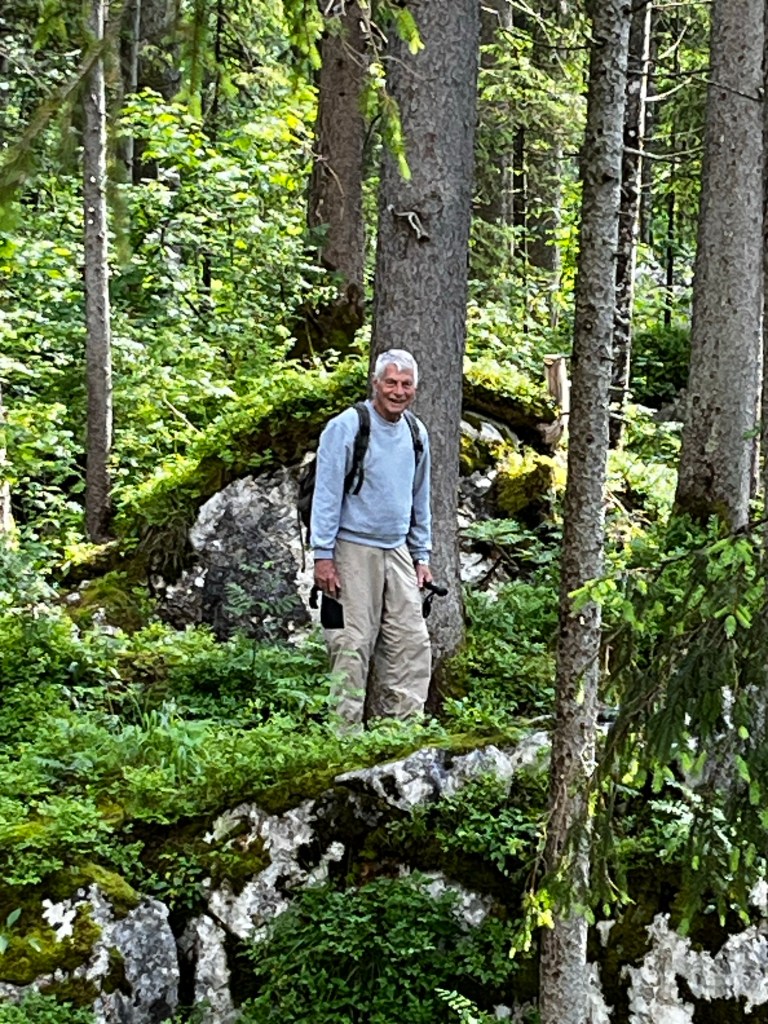
So, at Hintersee, park at the hotel (and pay the fee. Trust me. It’s worth it). Take the path that will lead you clockwise around the lake. You’ll know you’re going the right way because there’s a tiny, marsh-reed cove down a steep embankment by the path’s trailhead.
Walk maybe a quarter mile down a crushed gravel path. You’ll be steeped with the cool, chilled dampness of a Bavarian alpine pine forest and will be enchanted by what has to be a world inhabited by sprites and elves. If you’re not, turn around. Go back to the hotel and drink a beer. Have a piece of cake. Get a better, imaginative attitude. Or go home and keep out of my childhood dreamscape.
You’ll come to a cove where you’ll have a choice between a wooden, green-chipped-painted bench or a wide, sprawling flat boulder/rock formation that lies in the water like a sprawling, wide granite (I don’t know what type of rock it is and don’t care) dock.
That’s Family Rock. And you need to sit in the smooth bucket seat at the rock’s tip and blow bubbles or throw bread or duck food or whatever is healthy to the mallards who will swim by and scold you if you are stingy with your food. Note. They are not interested in soap bubbles. I tried.
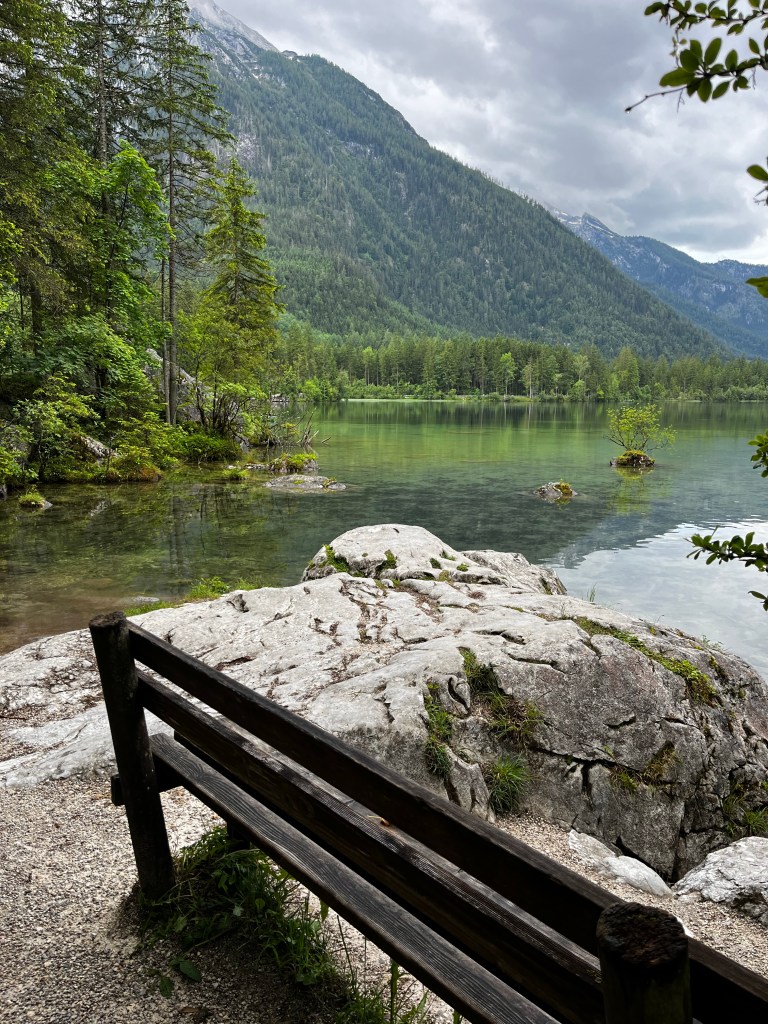
If you look in the middle-left edge of the above picture, you will see a triangular boulder with pine trees at its base beside the water’s edge. Pay attention to that boulder. It’s important.
Leave Family Rock. Continue in your clockwise hike around the lake. Take maybe twenty steps (depending on your leg’s length and stride). You should be back in the forest. To the left is a pine wood barrier.
To the right is a grove of tumbled rocks imbedded in a soft, dark brown, pine needle earth. The land gently slopes toward the water’s edge and long, slender pine trees canopy the space.
You are in Beckon Land.
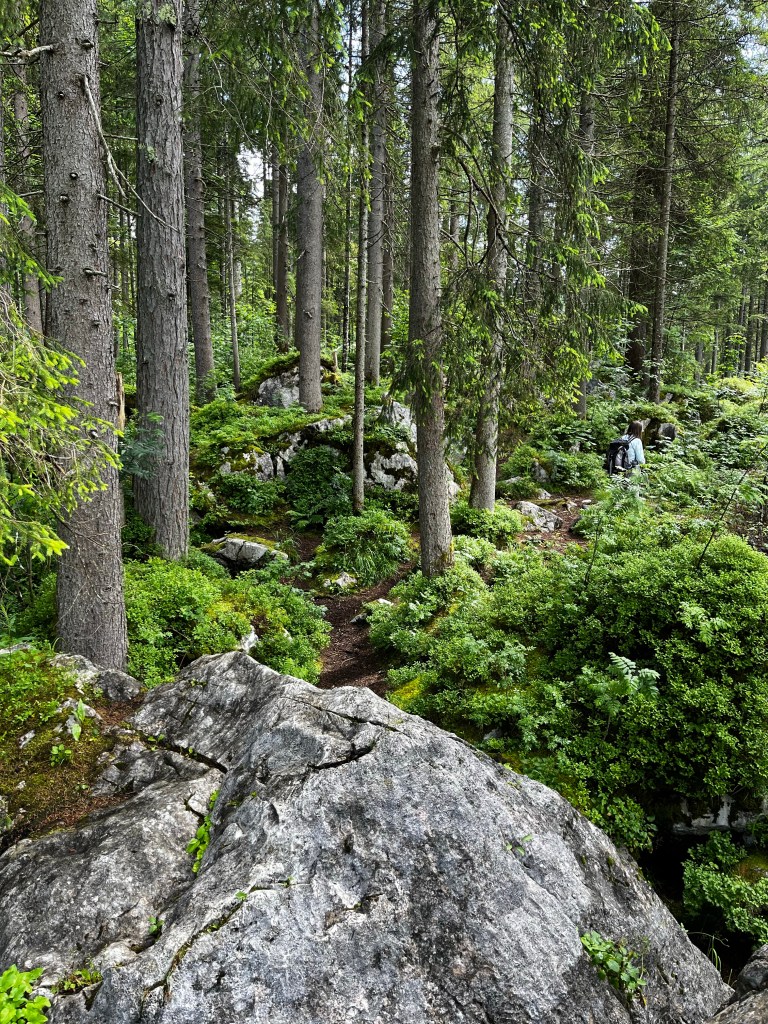
Remember that triangular rock down by the water’s edge? That was the dominant feature of this world. And it even had the most perfect name.
Big Rock.
Big Rock was Peter’s first main hiding place. He learned that scurrying up its face (the side facing the water) lead to a little niche where the rock had split. Tuck in there, and he couldn’t be seen from Base.
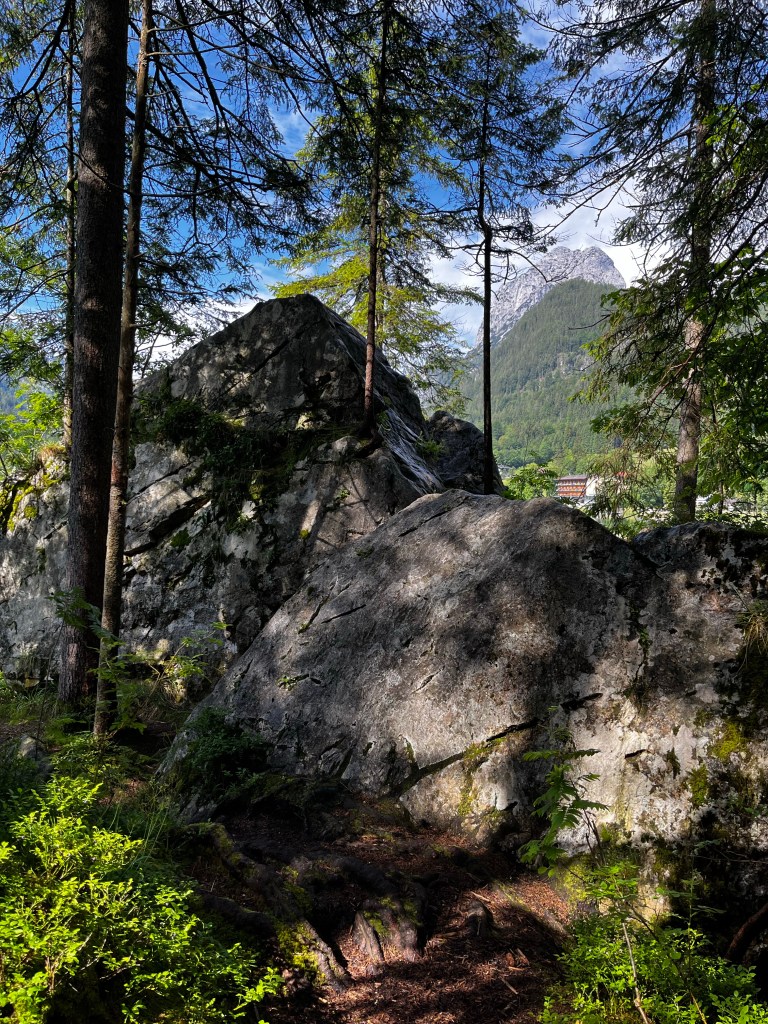
As I wrote, Big Rock had a deep crack in it that was the perfect size for a slender 12 year old, fearless boy. And that boy learned that when It approached from down by the water’s edge that there was a toe-wide crack spanning the circumference of Big Rock and with perfect balance and agility combined with brazen self-confidence that this 12 year old could scurry around the face of Big Rock and evade capture.
Double Jerk.
Peter soared. He fearlessly flew and I was tethered to the Earth. Just below Big Rock was an alcove where I hid by squeezing between two rocks. That was my usual spot until I found Mermaid Rock. More on that spot later.
I mounted Big Rock and hid in its cranny. But I could never summon Peter’s dexterous courage to shimmy around the rock and avoid our predating father. And so I was found every time I summited Big Rock while Peter straddled the pine sapling and melted into the shadows.
A year ago, I returned to Germany and went to my old childhood haunts. Peter was ill at this point and I needed to see our world without the full taint of his complete absence. I scaled Big Rock and stood in our old niche, too old to comfortably squash and tuck myself down. I took pictures of our Beckon world.
And Dad traipsed along the soft Earth, his footfalls making deep, baritone notes within the forest. He stood at Base and surveyed our world that felt so much smaller now.
He spied me and where I was standing. He lifted a hand and gave a quick, sharp wave.
A beckon.
Peter was my rock throughout my childhood and teenage years. As his little sister, I dutifully hated him and tried so hard to be just like him. But my footprints could never match his. They were within. They layered against. They were absorbed by.
I was terrestrial. I stood in my alcove below Big Rock and watched the mallard ducks skim the cold water’s surface. Peter skimmed the surface of Big Rock. Going in clockwise circles and always winning the game.
My children are adults. They might be too old to start playing. Or, maybe I need to loosen my bones and show them how to climb, to grab the sapling pine tree growing from the crack spanning Big Rock’s waterside face and launch up the sheet, steep surface. And then tuck into the crevice when It has yelled
Ready or not….Here I come.
 Poetry, journals, vents, and musings of a distracted woman